
Why Intelligence Is Destroying Humanity: Left vs. Right Brain & Consciousness

Subscribe to the Consciousness Cartographer substack for more cutting-edge + grounded conversations around consciousness, spirituality, and the human condition.
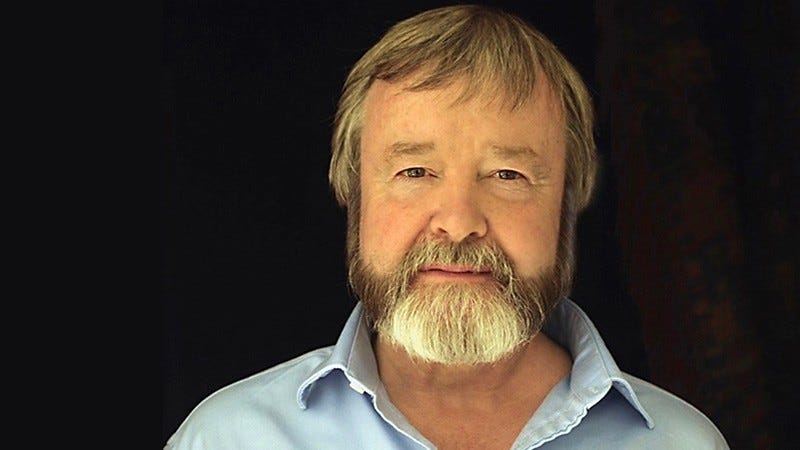
In this week’s conscious conversation, I had the deep pleasure of interviewing renowned psychiatrist and philosopher Dr. Iain McGilchrist on consciousness and the manifestation of the left vs. right brain in our present-day world.
You can watch our full conversation here.
TL;DR Summary
Modern civilization’s core mistake may be perceptual; we’ve become brilliant at control and manipulation, but disconnected from lived meaning.
Two modes of attention shape two worlds:
Narrow, analytical, control-oriented (map-making).
Broad, relational, contextual, meaning-sensitive (living reality).
Four levels of knowing:
Information = raw data.
Knowledge = data + lived familiarity.
Understanding = relational coherence.
Wisdom = humility born from experience and shaken certainty.
Consciousness may be fundamental, not produced by the brain.
Reality is participatory, and we co-create through attention.
Resistance is necessary for growth.
Friction both stops motion and makes motion possible.
Attention is moral.
How we attend shapes what comes into being.
The path forward:
Reintegrate analysis into lived experience.
Recover reverence for truth, beauty, and goodness.
Remember what we forgot and learn to see with openness.
We center our conversation around one Enstein’s most famous quotes:
“The intuitive mind is a sacred gift and the rational mind is a faithful servant. We have created a society that honors the servant and has forgotten the gift”
And so, we explore how we pay attention to the world and how we respond to it may determine whether humanity flourishes or fragments.
Our discussion ranged from neuroscience, poetry, eastern philosophy, AI, and the meaning of suffering itself.
The through-line? As McGilchrist says:
We have become extraordinarily good at manipulating the world, while slowly forgetting how to live inside it.
You can watch our full conversation here.
So let’s dive in.
Two Masters, Two Worlds
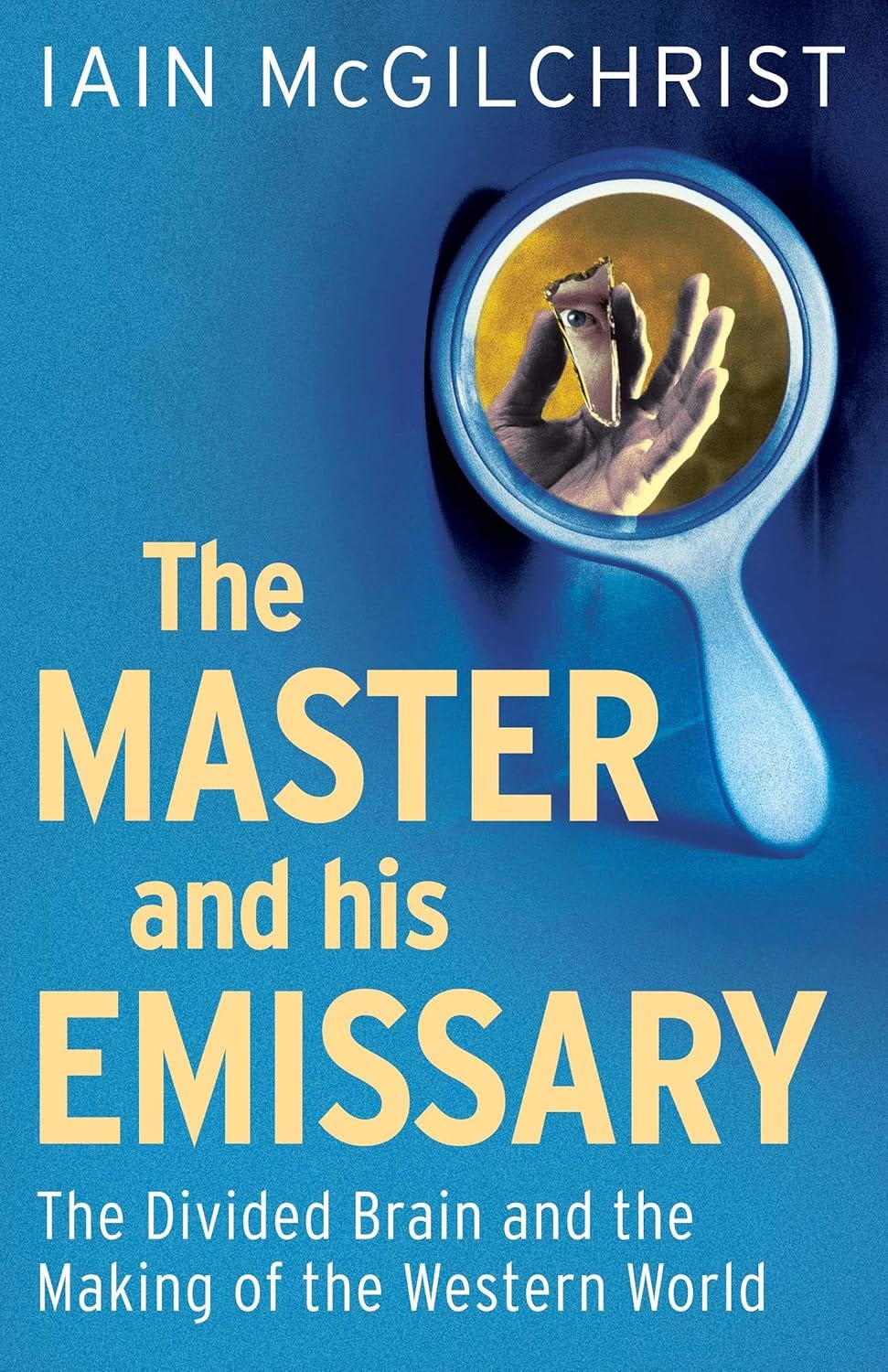
McGilchrist, famous for his book “The Master and His Emissary: The Divided Brain and the Making of the Western World,” challenges the pop-psychology caricature of “left brain = logical, right brain = creative.”
Both hemispheres do everything.
But they do it differently.
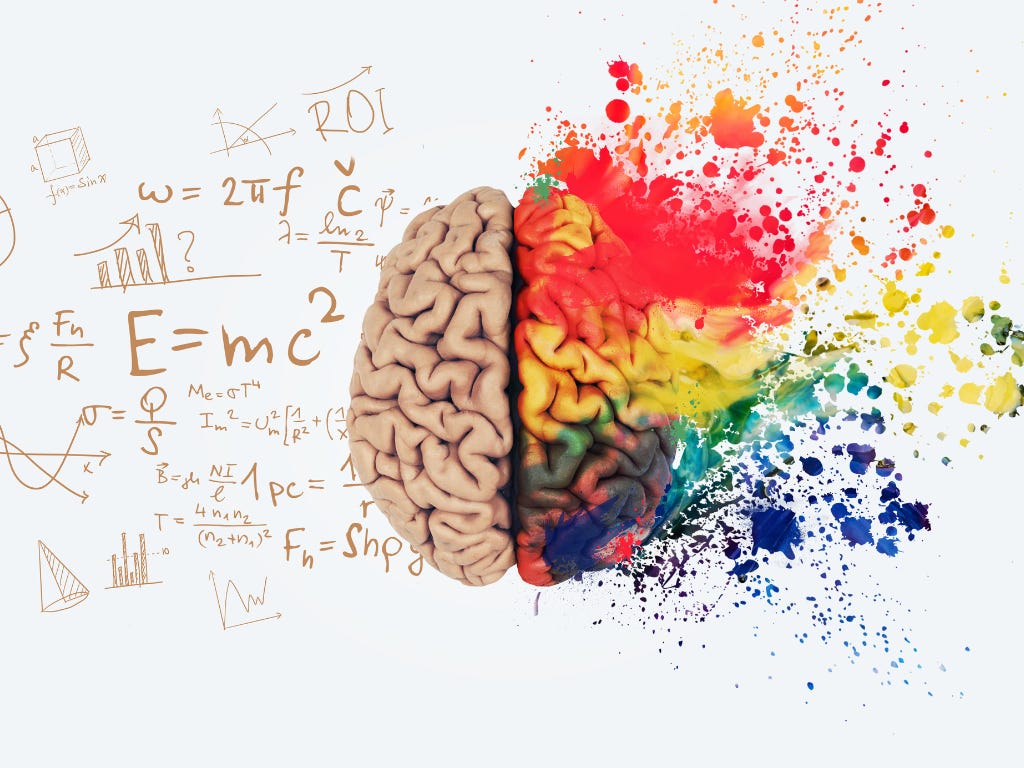
Left Brain: Mode of attention narrows in, targets, grabs, categorizes, and abstracts. It evolved to help us seize lunch before something else seized us.
Right Brain: It opens outward and stays vigilant to the whole scene: relationships, danger, beauty, ambiguity, and change. It perceives context and senses when something is not quite what it appears to be.
And they generate two experiential worlds.
And when one becomes dominant, especially the grasping, control-oriented style, we begin mistaking simplified models for the living reality they were meant to represent.
But as McGilchrist states… Maps are incredibly useful.
But if a map tried to include every house, every smell, every conversation, every emotional memory along a route… it would become useless.
Modern culture, as he suggests, has started to live inside the map where metrics replace meaning and screens replace presence.
We disassemble the map to understand it, but then stare at the pieces and wonder why the world feels hollow.
The Spectrum from Information to Wisdom
The next layer of conversation came when McGilchrist distinguished four levels of knowing:
Information is raw data, like text on book or numbers in a spreadsheet.
Knowledge includes facts but also familiarity born of experience.
You can know that Paris is the capital of France. Or you can know Paris because you lived there, walked its streets, loved there, suffered there.
Understanding arises when those experiences and facts form a coherent pattern, a web of relationships in which meaning emerges.
Wisdom is an experience that cannot be taught directly.
Akin to eastern Zen Buddhism, it mirrors the journey of a student growing into a master. It grows from attentiveness, humility, and ultimately from being shaken by life. Ignorance is what you have before you know. Wisdom is what remains after you realize how little you truly understand.
This is materialized in the form of art, poetry, and spiritual practices.
In a world drowning in information, McGilchrist says we may be starving for that deeper form of knowing…
What is Consciousness then?
The conversation eventually touched on the question that sits at the center of my own work: what is consciousness?
McGilchrist framed three possibilities.
The brain might produce consciousness.
It might transmit it, like a radio receives a signal.
Or it might permit it, shaping something more fundamental into the form of an individual mind.
He leans toward the third.
In his view, consciousness is basic and primary, not a late-arriving accident in a material universe.
It is an “ontological primitive” aligning with panpsychism.
Matter, therefore, may be a phase of consciousness, much as ice and vapor are a phase of water.
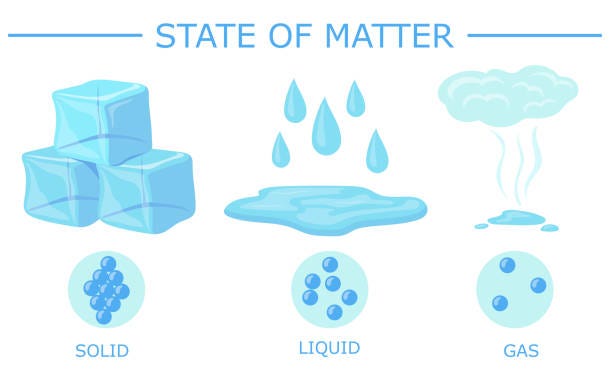
Different expressions of the same underlying reality.
And he said something that stuck with me: Matter gives us something crucial, and it’s called resistance.
Resistance creates stability through friction.
Without friction, you cannot drive on the road or fly a plane in the air.
And so, without resistance, nothing grows.
The cosmos itself appears creative. It is constantly differentiating, recombining, becoming.
In that sense, McGilchrist says we are participants, not spectators of reality.
Every encounter changes both sides.
Where we shape the world. And then the world shapes us.
The Importance of Intuition: The 9-Dot Experiment
Neuroscience experiments we discussed point to something surprising: temporarily quieting certain left-hemisphere processes can increase creative insight, mimicking Savant Syndrome.
Savant syndrome is a rare condition where individuals with significant developmental disabilities, often autism spectrum disorder, possess extraordinary, often prodigious, skills in specific areas like music, art, memory, or mathematics, creating a stark contrast with their overall cognitive functioning
Scientists used brain stimulation to mimic “savant-like” thinking to solve the 9-dot puzzle:
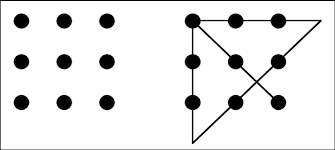
The Problem: Most people have a 0% success rate because the brain’s “filters” force us to see the dots as a rigid box.
The Hypothesis: Savants succeed because their brains lack these filters, allowing them to see raw data without mental constraints.
The Method: Researchers used tDCS (brain stimulation) to temporarily dampen the left hemisphere (logic/filters) and excite the right hemisphere (creativity/insight).
The Result: After just 10 minutes of stimulation, the success rate jumped from 0% to over 40%.
And so this demonstrates that suppressing “normal” executive function can unlock “hidden” problem-solving abilities by allowing the mind to literally think outside its own imposed boundaries.
A Practical View of Suffering
Toward the end of our conversation, we turned to suffering.
As we know, with so much information at the reach of our hands, we also see the darkness in every corner.
While McGilchrist states that pain ranges from inconvenience to catastrophe.
Yet again and again, meaning seems to arise not from avoiding resistance but from meeting it with openness and resolve.
He told an ancient Chinese story:
A farmer loses his horse.
“Bad luck,” say the neighbors.
“Who knows?” he replies.
The horse returns with another.
“Good luck.”
“Who knows?”
His son breaks a leg.
“Bad luck.”
“Who knows?”
War comes.
The injured son is spared.
And so he says we never know what events will become.
Friction stops motion. It also makes motion possible.
We are all, whether we realize it or not, transmitting something by how we live.
And we try our best and continue to move forward.
Question We’re Left With
As the conversation closed, one idea lingered.
How can we consciously participate in a living cosmos?
Where the definitions, not just words on a page, for meaning become something more.
Where we meet it and respond to it, and receive the experience with openness and presence.
Perhaps the future of humanity depends less on what we build…
…and more on how we learn to see again.
So here are the questions for you:
How is modern life making you smarter but less “wise”?
If you’re honest with yourself, where in your life are you living inside the “map” instead of seeing the bigger picture and meaning behind its parts?
If this conversation resonated with you, consider subscribing to Consciousness Cartographer for deeper explorations at the intersection of neuroscience, meditation, biofield science, and the mysteries of mind and meaning.
I’m writing a disturbingly similar article right now. Even with the Einstein quote 😂
Mgilchrist is a favourite of mine and this is a fantastic summary.
Been meaning to read "The Master and his Emissary" for a while.